

Towards the leading College of Law and Justice in Africa
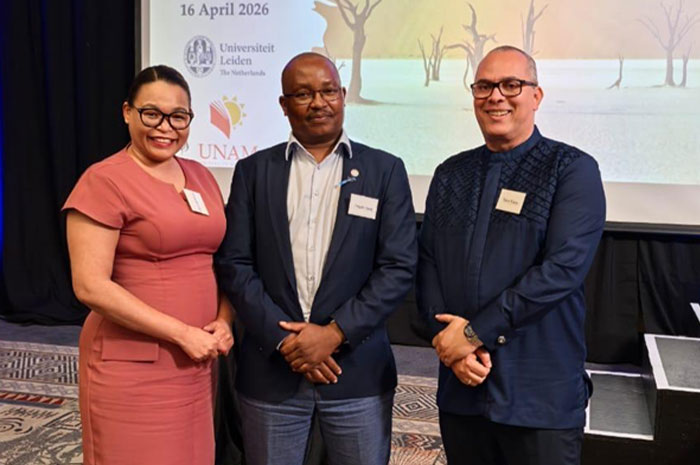
Left to Right: Chrizelda George (Walvis Bay Airport), Prof Angelo Dube (UNISA), Vasco Vieira (African Civil Aviation Commission of the African Union).
On 16 April 2026, the 17th IIASL International Air Law Conference was held in Windhoek, Namibia, under the stewardship of Minister of Justice, Filemon Immanuel. This set in motion a week-long engagement that seamlessly fused academic inquiry with industry urgency.
What began as a focused one-day conference evolved into a three-day moot court competition in aviation law – marking a historic first for the African continent. This convergence of scholarship and practice provided fertile ground for institutions such as the University of South Africa (UNISA) to demonstrate how academia can meaningfully shape the trajectory of aviation development in Africa.
The opening remarks by Steven Truxal, Director of the International Institute of Air and Space Law (IIASL) at Leiden University in the Netherlands, underscored the significance of hosting the moot on African soil for the first time. His reflections were complemented by contributions from Dr Kenneth Kariseb of the University of Namibia and Ericsson Nengola of the Namibia Civil Aviation Authority, both of whom emphasised the importance of dismantling the perception of aviation law as an elitist domain. Their interventions resonated with a broader theme that would permeate the conference: the democratisation of aviation knowledge and practice.
It was within this context that UNISA’s presence, anchored by the work of the Aviation Law Working Group and the Engaged Scholarship on the Rural Aviation Economy (Project ESRAE), emerged as particularly compelling. The institution’s participation was not merely representational; it was deeply substantive. Drawing from ongoing research within these initiatives, UNISA’s contributions illustrated how engaged scholarship can bridge the gap between theoretical frameworks and operational realities.
The panel on Regional Connectivity and Liberalisation, featuring CLAW’s Professor Angelo Dube alongside industry and regulatory stakeholders, interrogated the persistent barriers to the implementation of the Yamoussoukro Decision and the Single African Air Transport Market (SAATM).
UNISA’s intervention in this panel was informed by the empirical and policy-oriented work of Project ESRAE (led by Adv Konanani Raligilia), coupled with the work of the Aviation Law Working Group (ALWG), which foregrounds the often-overlooked rural aviation economy. By situating connectivity within broader socio-economic ecosystems, the project challenges narrow conceptions of aviation as an urban-centric industry. Instead, it advances a vision of aviation as an enabler of rural development, agricultural logistics and inclusive economic participation.
Equally striking was UNISA’s articulation of the evolving role of higher education institutions in the aviation sector. Moving beyond traditional pedagogical boundaries, the university has undertaken bold and innovative steps to embed itself within the industry. Chief among these is the recent acquisition of an airport, an unprecedented move that featured prominently in the conference presentations. This strategic investment positions UNISA not merely as a knowledge producer but as an active participant in aviation operations, training and infrastructure development. The audience’s response, marked by both curiosity and admiration, attested to the transformative potential of such an approach.
This institutional repositioning is further evidenced by the development of new academic programmes and the supervision of cutting-edge doctoral research. Recent PhD graduates under Professor Dube’s supervision, focusing on unruly passenger regulation, regulatory sandboxes in the unmanned aerial vehicles sector, and accident investigation frameworks in South Africa, exemplify the kind of scholarship that directly engages with industry challenges. These and many other outputs, emanating from the ALWG, underscore the capacity of African universities to generate contextually relevant knowledge that informs policy and practice.
A recurring concern throughout the conference was the fragmentation of aviation discourse at the continental level. The consensus was clear: Meaningful transformation of the African aviation sector requires a whole-of-government approach. UNISA’s interdisciplinary orientation, particularly through initiatives such as Project ESRAE, and the work of the ALWG offers a model for how such integrative thinking can be operationalised.
The conference also delved into specialised areas such as the Cape Town Convention, with discussions on aircraft financing, leasing and cross-border asset protection, which captured significant attention. These are domains that demand sophisticated legal and financial expertise. Needless to say, these are areas in which universities must play a proactive role. UNISA’s commitment to developing curricula that address these emerging needs reflects a broader understanding of aviation as a complex, multi-dimensional industry.
Reflecting on the conference, it becomes evident that UNISA is charting a distinctive and ambitious course in the aviation sector. Through the integrated work of the Aviation Law Working Group and Project ESRAE, the university is not only contributing to scholarly discourse but actively shaping industry practice. Its innovative investments, interdisciplinary research and commitment to engaged scholarship position it as a leader in reimagining aviation in Africa.
*By Prof Angelo Dube, College of Law, Unisa
Publish date: 2026-06-29 00:00:00.0
 Unisa brings world's leading mission scholars together to tackle global challenges
 Unisa hosts workshop to empower postgraduate student support and quality assurance
 Learn how astronomy and space science are strengthening SA's research and innovation landscape
 From campus mailboxes to two million followers: The untold story of Unisa's digital revolution
 Working, studying, succeeding: Inside Unisa's life-changing employee education programme