
Held on 22 April 2026 at Unisa’s Muckleneuk Campus, the Department of Leadership and Transformation (DLT) hosted a seminar titled "Facilitation of Epistemic Plurality by Embracing African Knowledge Systems, Languages, and Intellectual Traditions".
In her opening remarks, Prof Grace Khunou, Executive Director: DLT, acknowledged that Western knowledge remains dominant in universities. As such, she highlighted the need for the seminar to unpack the importance of considering epistemic plurality in universities. "We need to reclaim our cultural indigenous knowledge and language if we want to sustain ubuntu," she said.
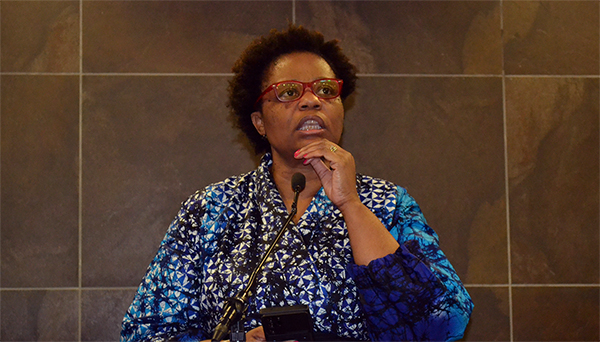
Prof Grace Khunou, Executive Director: DLT, delivering the opening remarks
Outlining the rationale for the seminar, Dr Phumzile Dlamini, Deputy Director of Governance, Leadership and Management in Unisa’s Human Resources Department, remarked that Unisa cannot be a university of the land if it does not promote indigenous knowledge. She further asserted that language relevance must be incorporated into how we teach to promote equitable access.
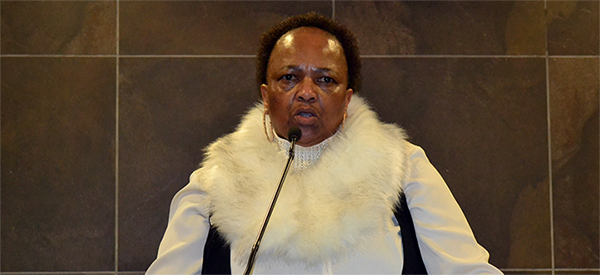
Dr Phumzile Dlamini
With colonisation still discussed daily, the narrative of the clash between Western knowledge and cultural systems must be changed. "In improving efficiency and measuring productivity," she noted, "we need to reflect on our system policies and language to see if we are truly impacting people’s lives."
Dr Pedro Mzileni, Senior Lecturer in the Department of Sociology at the University of Zululand, argued that the status of African languages today is a concern because South Africa is a settler colony, an underestimated fact that continues to shape how people write academically.
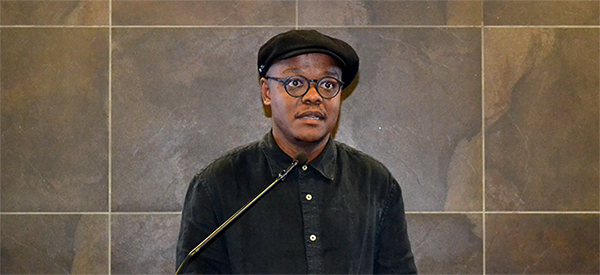
Dr Pedro Mzileni
For him, language is a battlefield for social engineering and social control. "In 1959," he said, "an act was passed to regionalise and tribalise African languages and liquidate African intellectual cultures." Additionally, he emphasised that South Africa’s economy, language and education must align with its culture in order for its citizens to become sovereign African people.
Referring to an article he wrote in 2019, in which he underscored a problem he called bibliometric coloniality, he declared that South Africans are trapped in a Western knowledge power matrix and need to move beyond it to achieve epistemic plurality. "We need to reinforce the development of writers who are going to advance African languages and get listed so as to start building their intellectual profile," he concluded.
Executive Director of the Department of Tuition Support and Facilitation of Learning (DTFSL), Prof Meahabo Magano, aligning with the essence of the theme, underscored that the DTFSL is trying to bring together various philosophical underpinnings and present them in a practical book format so they're doable.
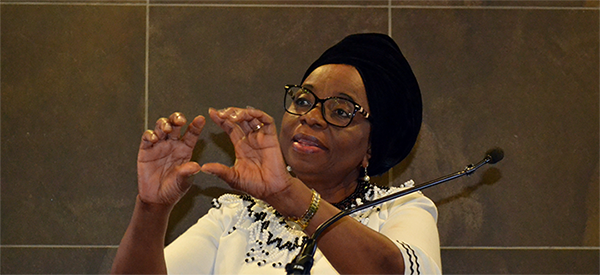
Prof Meahabo Magano
She referred to her days as a tuition manager in the College of Education, when academics acknowledged Dr Esther Mahlangu’s IsiNdebele art. "This," she said, "inspired them to bring her work into ethnomathematics, a start of their own transformation."
In his presentation, Director of Language Services, Dr Rakwena Monareng, indicated that although the background is known and students are being taught, a monolithic approach is still used. "We cannot keep theorising about decoloniality, but not act on it," he said. "To conquer a monolingual and monolithic approach that disturbed students’ interest in wanting to find who they are and expressing who they are, the university needs to be a sense-making and knowledge-making production."
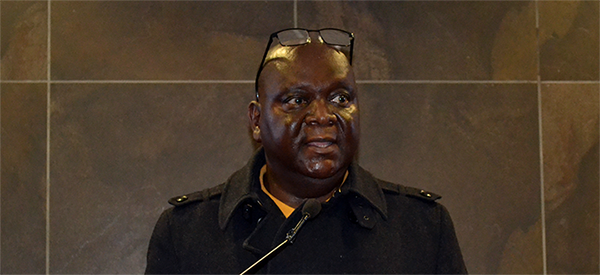
Dr Rakwena Monareng
Monareng stated that language serves as a connective medium expressed through different languages. "Bringing together different students using African languages will generate a new knowledge set that has never been crafted before," he concluded. "Language policy speaks about multilingualism, and we need to perform a curriculum audit concerning this aspect."
Dr Nicky Tjano, Director: Teaching and Learning Strategy, Projects, and Portfolio Performance in the Office of the Acting Vice-Principal: Teaching, Learning, Community Engagement and Student Support, shared his views on the essence of education, learning, and transformation. Proceeding, he pointed out that we now live in an era in which we are corporatising education; thus, students' integrity is tested rather than their intelligence.

Dr Nicky Tjano
"The essence of education is not to get a job or certificate," he said, "it is to be a holistically developed person who can positively impact society."
For him, this essence has been replaced with the matrix. Considering universities' expanding roles beyond teaching and learning, he questioned whether universities must be reinvented to serve a learning society, particularly concerning the ivory tower. "We need to transition from being seen as working to impactful transformation," he stated in closing.
An interactive question-and-answer session concluded the seminar.
* Article and pictures by Moleboheng Mpafa, Communication Intern, Department of Institutional Advancement
Publish date: 2026-04-24 00:00:00.0
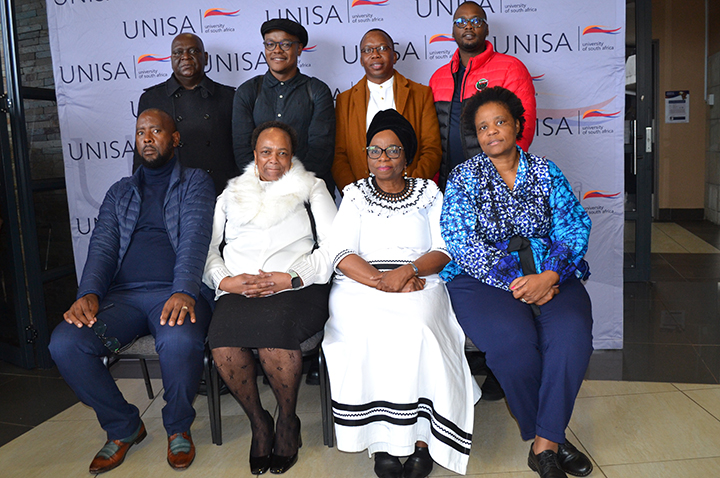 Unisa seminar examines cultural knowledge and language as key ingredients of ubuntu
 Unisa on the global stage: Research excellence driving Africa's textile future
 From Pretoria to Frankfurt: Unisa's rise on the global stage
 Unisa ceremony marks milestone in arts education
 Unisa Western Cape hosts 2026 postgraduate orientation