
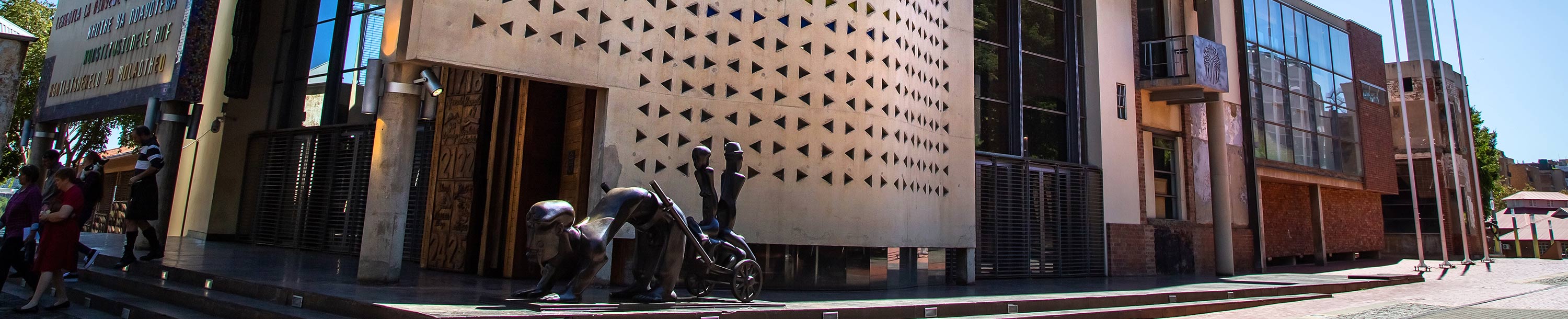
Towards the leading College of Law and Justice in Africa

Prof Paul Mudau and Dr Tendai Mbanje
This year marks fifty years since the Soweto Uprising of 16 June 1976, a day that gave birth to South Africa’s vibrant culture of youth-led protest. On that day, thousands of schoolchildren marched peacefully against the apartheid government’s decree that Afrikaans be imposed as a compulsory medium of instruction. For black students, Afrikaans was not merely a language; it was the embodiment of systemic oppression under the Bantu Education Act of 1953, which entrenched racial inequality and denied them access to quality education.
The movement, influenced by the Black Consciousness Movement (BCM) led by Steve Biko, and the South African Students Organisation (SASO), the youth mobilised to defend their dignity and right to equal education. The brutal police response, including teargas, live ammunition, and the killing of children, transformed a peaceful march into a nationwide uprising. The image of Hector Pieterson’s lifeless body carried by Mbuyisa Makhubo, with his sister Antoinette Sithole running alongside, became an enduring symbol of resistance. More than a protest against language policy, June 16 was a declaration of human rights, a refusal to be silenced, and a turning point in South Africa’s struggle against apartheid.
The Soweto Uprising embedded youth voices at the heart of South Africa’s political culture. It demonstrated that young people were not passive recipients of oppression but active agents of change. The uprising galvanised international condemnation of apartheid strengthened liberation movement within and beyond the borders of South Africa, and inspired generations of activists. It also established a golden thread that runs through South Africa’s protest culture from 1976 to 2026: the insistence on dignity, equality, and justice.
Youth Day is therefore not only a commemoration of past sacrifice but a recognition of the enduring role of young people in shaping the nation’s trajectory. Importantly, the right to protest, denied and brutally suppressed under apartheid, is now constitutionally guaranteed. Section 17 of the Constitution of the Republic of South Africa, 1996 explicitly affirms that “everyone has the right, peacefully and unarmed, to assemble, to demonstrate, to picket and to present petitions.” This legal recognition marks a profound shift. Protest is no longer criminalised but understood as a legitimate expression of democratic participation.
In the democratic era, the spirit of 1976 evolved into new forms of protest. The 2000s and 2010s saw service delivery protests led by young community leaders demanding water, electricity, housing, and sanitation. These demonstrations revealed the gap between constitutional promises and lived realities, underscoring that democracy without material justice remains incomplete. In 2015, the #RhodesMustFall movement at the University of Cape Town demanded the removal of Cecil John Rhodes’ statue, sparking a broader call to decolonise education and confront institutional racism. This was followed by #FeesMustFall (2015–2016), a nationwide student movement demanding free, decolonized higher education. The movement forced government concessions and reshaped the discourse on access to higher learning, proving once again that youth-led mobilisation could alter national policy. These protests were not only political but legal in nature, invoking constitutional rights to equality, dignity, and education, and reminding the state of its obligations under the Bill of Rights.
Youth activism has also confronted gender inequality and violence. Between 2018 and 2021, students across the country organised protests against femicide and sexual violence, insisting that freedom must mean safety for women. These demonstrations highlighted the intersection of patriarchy and inequality and demanded that constitutional rights to dignity and equality be realised in everyday life.
More recently, youth-led protests have emerged around economic anxieties, unemployment, and migration. Some of these have taken controversial forms, such as anti-foreigner protests framed as struggles for jobs and resources. While divisive, they reflect the frustrations of a generation grappling with high unemployment, poverty, and inequality, conditions that threaten the promise of democracy. Here too, the Constitution provides a framework: Section 9 guarantees equality, while Section 27 affirms socio-economic rights, underscoring that protest movements are often demands for the realization of constitutional commitments.
Across five decades, South Africa’s protest culture has shown both continuity and change. Continuity lies in the central role of youth, their insistence on dignity, and their willingness to confront authority, whether the former apartheid police or the current democratic government. Change lies in the issues and methods, from language and pass laws to education, gender violence, and economic exclusion; from street marches to social media campaigns that globalise local struggles.
While occasional police violence remains a painful continuity, some reforms have altered its character over the decades. Under apartheid, police were instruments of repression, meeting peaceful protest with lethal force. In a democracy, the South African Police Service (SAPS) operates under a constitutional mandate to “prevent, combat and investigate crime, to maintain public order, to protect and secure the inhabitants of the Republic and their property, and to uphold and enforce the law.”
While incidents of brutality have persisted, notably during service delivery protests and the Marikana tragedy, there has been progress in facilitating peaceful demonstrations. Increasingly, police are tasked with enabling rather than suppressing protest, reflecting the constitutional recognition that protest is a cornerstone of democracy.
The impact of youth-led protest movements is undeniable. They have forced governments to confront uncomfortable truths, reshaped public discourse, and expanded the boundaries of rights and freedoms. They have also revealed the resilience of South Africa’s democracy, which, despite its flaws, continues to provide space for dissent and mobilisation. Yet challenges remain. Crime, unemployment, and unequal access to education continue to undermine the aspirations of young people. Many graduates remain unemployed, and economic inequality persists. These realities demand that the protest culture born in 1976 continue to evolve, addressing not only political rights but also socio-economic justice. The Constitution provides the legal foundation, but it is youth activism that breathes life into those rights, ensuring they are not abstract promises but lived realities.
Youth Day is therefore both a celebration and a call to action. It celebrates the courage of the unsung heroes of 1976 and the generations that followed, who refused to accept injustice and demanded dignity and equality. It also calls on today’s youth to continue that tradition, confronting the challenges of unemployment, inequality, and exclusion with the same determination that characterised Soweto fifty years ago.
The vibrant protest culture born in 1976 has made South Africa what it is today, a society transformed by the voices of its youth, yet still striving to fulfill the promise of freedom. As we look to 2026 and beyond, the challenge is to honour that legacy by ensuring that the rights enshrined in the Constitution are not only formal guarantees but lived realities for all. Protest, once criminalised under apartheid, is now a constitutional right and a vital democratic practice. It remains the heartbeat of South Africa’s journey toward dignity, equality, and justice.
*By Prof Paul Mudau and Dr Tendai Mbanje
Prof Paul Mudau: Associate Professor, Department of Public, Constitutional and International Law, College of Law, Unisa
Dr Tendai Mbanje: A notable governance and elections scholar, widely recognised for his expertise in African governance and electoral processes. Through his work, he critically examines the institutional frameworks and normative standards that underpin democratic governance in Africa.
Publish date: 2026-06-17 00:00:00.0
 Eastern Cape autumn graduations celebrate excellence, achievement and new beginnings
 Unisa's leadership outline how resolutions are translated into measurable progress
 Unisa exhibition celebrates African literary heritage
 Summit set to propel Unisa towards enhanced local and global performance
 Unisa hosts international delegates at African musical instrument workshop