

The African college of excellence in the social and human sciences
“Our tendency to exclude others, our interpretation of the scriptures and our theology of sin have all combined to stigmatization,” said Dr Nontando Hadebe as she began her presentation at the Nothing without us seminar hosted by the Department of Philosophy, Practical and Systematic Theology in the College of Human Sciences.
She said that witnessing the tipping edge of violence against LGBTIQ people based on the bible to justify exclusion, vilification and demonisation evoke violence in society that is unbearable to one. She read the story of how the late Banyana Banyana soccer star, Eudy Simelane, got gang-raped and brutally beaten and killed because she was a voracious equality rights campaigner and one of the first women to live as a lesbian in KwaThema, Gauteng.
Dr Hadebe said that liberation theologies including Africans, women, the poor, and people with disabilities, are examples of the voices of the oppressed claiming their epistemological privilege to speak for themselves and challenge the use of the bible to exclude, marginalise and discriminate against them. We need to make people aware that there is a relationship between marginalisation and violence.
“God coming down to the oppressed as a liberator and sending Jesus; liberation starts with God,” she said, encouraging people to understand that every human being is made in the image of God.
Also speaking at the seminar was Reverend Thomas Ninan, an ordained pastor from the National Council of Churches in India. He said that it is important to have this conversation in a positive way because there is a lot of phobia regarding the LGBTIQ community across the globe.
“There are very few partners who are willing to journey with faith groups like us. There is a need for finding the right ways of starting a conversation around sexuality and gender diversity. In India there is an imminent gap between academics and the church ministry.”
He said there is value in listening to real life stories, which helps people to understand the importance of the “right conversations around human sexuality”, which ends up developing a platform for mutual understanding and engagement.
Reverend Ninan said he has learned that there is a need to find ways to engage in building trust for a continuing process of dialogue and learning and factors such as vulnerabilities, HIV, positive sexuality, life realities of the marginalised contribute towards a strong rationale for churches. He ended his presentation by suggesting that sensitisation is vital and needs to continue in an enormous way.
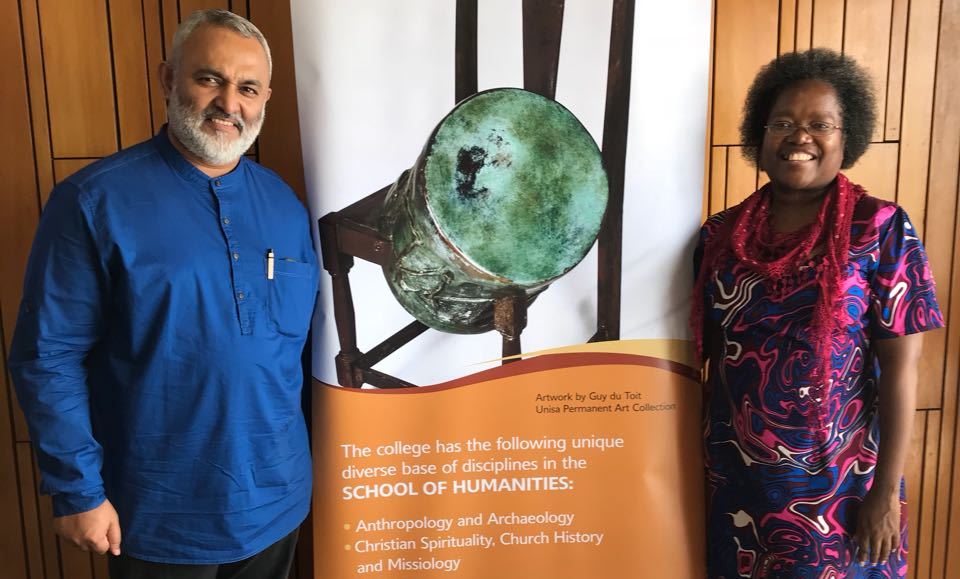
Pictured are guest speaker Reverand Thomas Ninan and Dr Nontando Hadebe from the Department of Philosophy, Practical and Systematic Theology.
*By Nomshado Lubisi (CHS communications and marketing)
Publish date: 2017-11-10 00:00:00.0
 Alumnus marvels at Unisa's transition from paper trails to digital excellence
 Unisa accounting career engagement draws students and industry leaders
 Unisa business management fundi calls for new research agenda on small businesses
 Strategic engagement between Unisa and UNAM opens doors for collaboration
 Unisans shine at major research conference