

The African college of excellence in the social and human sciences
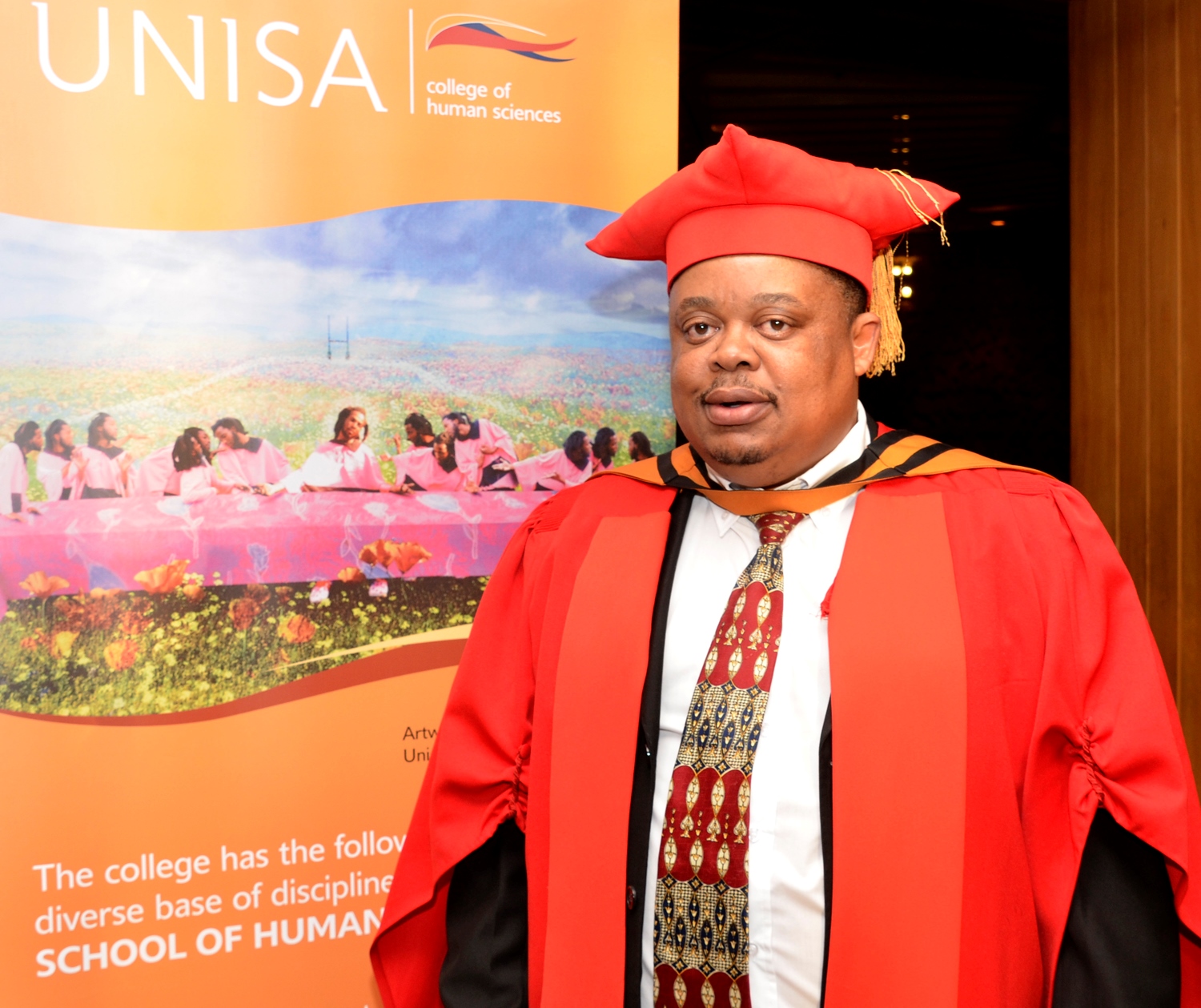 Prof Pascah Mungwini, a lecturer in the Department of Philosophy, Practical and Systematic Theology, in the College of Human Sciences delivered his inaugural lecture on 24 August 2017. Entitled, The question of epistemic justice: polemics, contestations and dialogue, Professor Mungwini said that his lecture reflected on the “unfinished humanistic project of decolonisation” in Africa.
He said his lecture is an invitation to examine the problem of epistemic injustice from a philosophical standpoint. The core of his argument is based on the position that there is an epistemic dimension to Africa’s problems, and the struggle for epistemic justice is as fundamental to humanity as all other struggles for social justice. Epistemic justice is a corollary of global justice.
Prof Mungwini said that addressing the problem of epistemic injustice calls for multiple efforts and initiatives. Among these is commitment to new canon building across the disciplines and adopting strategic particularism as a paradigm and philosophical framework in our academic projects. He believes that to confront epistemic injustice and thus to restore parity and equilibrium, polemics, contestations and dialogue are inevitable, and in this endeavour, he said the main goal should be to reclaim our position in the conversation of humankind.
He examined the question of epistemic injustice from a context of the polemics, contestations and possibilities for dialogue. He is of the view that the methods by which we seek to extricate ourselves from the forms of domination and marginalisation on the knowledge front have to be informed not only by being aware of the system that has been put in place to achieve such repression but by understanding the source of its power and the fuel that keeps it alive.
On a more practical note, Prof Mungwini highlighted that if we are to look at the ongoing debate concerning the decolonisation of knowledge and the whole subject of decoloniality in particular, one can argue that it is at this moment defined at almost every stage by polemics, contestations and dialogue. For it has provoked emotions of entitlement, optimism, resistance, anger, fear, despair and even withdrawal.
To conclude, Prof Mungwini made the following two claims: “Here is the truth as it is” and “here is the truth as we see it” and described them as two propositions of different epistemological order. In one of these he said, we can discern the roots of epistemic injustice which is one of the unfinished projects of our time. He said the former’s absolutism precludes any alternative voice, while the latter, by presupposing interpretational variations, places objectivity in parenthesis, thereby freeing space for dialogue and diversity. By restricting “philosophy proper” to the Greeks and their heirs, Professor Mungwini indicated that the west was priming itself to proclaim truth in the first of the two senses above. He pointed out that the challenge today is to reassert our philosophy not by jettisoning other philosophies but by reading them from our own historical and particularistic location in the spirit of philosophy as the conversation of humankind.
*By Katlego Pilane
Publish date: 2017-09-11 00:00:00.0
 Masterclass unpacks the power of glocalisation in global marketing
 Unisa and NPC expand partnership to promote the journalism profession
 Unisa's renowned scholars nominated for South Africa's Science Oscars
 Unisa celebrates the life and legacy of Miriam Makeba
 Unisa seminar examines cultural knowledge and language as key ingredients of ubuntu