

The African college of excellence in the social and human sciences
On 28 June 2017, Professor Servaas van Deventer delivered his inaugural lecture which he unpacked as a story about a ghost. “It is a ghost we know rather well because we keep it really close to ourselves, in fact we keep it at the very core of ourselves,’’ he said.
In the first part of the story, Professor Van Deventer pointed out that stories never simply represent, they also constitute. He said a narrative is never completely true, not even when it claims to be a report of real events. But it is also never purely fictive. He believes that there is always some truth in fiction, and something fictive about the truth. “This happens because narratives are endlessly layered, they continuously retell other narratives.”
Professor Van Deventer then explained the second part of his narrative entitled The mystery of the ghost, as a journey to the Centre of reality in a century of information and artificial intelligence. He said our metaphor is not the machine born and bred in Newtonian force but is the quantum ghost in the machine, or perhaps more precisely the ghost of the quantum gap at the heart of the physical machine.
According to Professor Van Deventer, the ghosts of intelligence glow in the machines that surround us, constantly confronting us with the question of our humanity. He said that even more than a century of psychology did not do much to help us but only served to fragment us into a bewildering array of motivations, emotions, cognitions, personalities and pathologies to which he said to a certain point “We are bound to ask, who are we?”
According to Professor Van Deventer, to dance with the ghost is to dance with ourselves, and more specifically to dance with the gap, with the unknowable, within ourselves. Something must come from nothing he said. “It is a dance of desire, the desire for an answer to the question: What am I? The journey to the centre of this reality is a dance, and the traveler is a dancer”.
He added that the movements of this dance are quite complicated. He believes that it is not a dance that moves through space and time but one with space and time. It is a dance that spatialises and a dance that temporalises and he named it “difference”.
Professor Van Deventer concluded by introducing the beginning of another story. He said some believe that the story of the decolonised I begins with two individuals, you and I, and that the relationship between you and I is a function of who I am and who you are. According to this belief the journey to the decolonised I is one in which you and I grow closer, to become more similar, until one day we become like one.
He went on to say that, others believe that the story of the decolonised I begins with a relationship from which both you and I are born. According to this belief the journey to the decolonised I is one in which the relationship grows stronger and becomes more clearly expressed, until one day we are both reborn as decolonised ls.
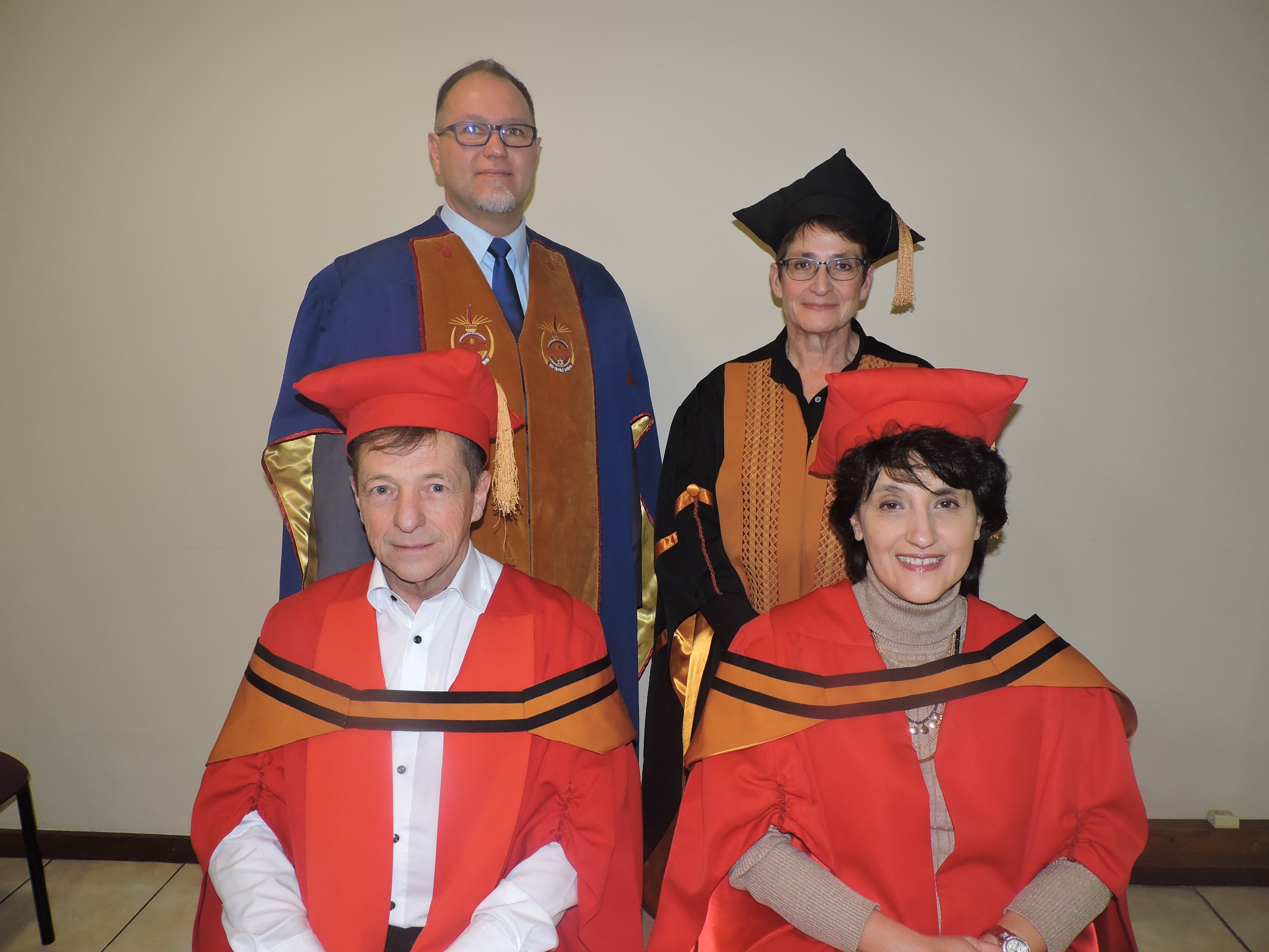
Pictured are, standing, Prof. Lessing Labuschagne (Vice Principal: Research, Postgraduate Studies, Innovation and Commercialisation), and Prof. Linda Cornwell (Director: School of Social Sciences, CHS); and seated are, Prof. Servaas van Deventer (Department of Psychology, CHS) and Prof. Maria Papaikonomou (Acting COD: Department Psychology, CHS).
* Compiled by Katlego Pilane (CHS communications and marketing)
Publish date: 2017-07-10 00:00:00.0
 Unisa brings world's leading mission scholars together to tackle global challenges
 Unisa hosts workshop to empower postgraduate student support and quality assurance
 Learn how astronomy and space science are strengthening SA's research and innovation landscape
 From campus mailboxes to two million followers: The untold story of Unisa's digital revolution
 Working, studying, succeeding: Inside Unisa's life-changing employee education programme