

The African college of excellence in the social and human sciences
Bidding an institution that has become one’s home and your colleagues that have become like family is never an easy task but for 15 staff from the College of Human Sciences, the time to say goodbye to Unisa has come.
These staff members were acknowledged on 30 November at a retirees farewell function hosted by the CHS Dean, Prof Andrew Philips. In his absence, he was represented by Prof Mabel Majanja (School of Arts Director and Acting Dean) and Dr Britta Zawada (Deputy Dean), both of whom thanked the employees for their service to the college, university and the South African and African community.
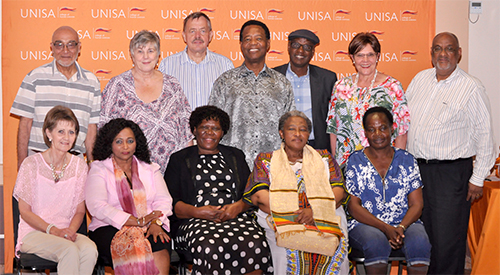
Pictured standing are, Prof Yusuf Dadoo (Department of Religious Studies and Arabic), Prof Janetta Roos (Department of Health Studies), Prof Pieter Labuschagne (Department of Political Sciences), Prof Ramathate Tseka Hosea Dolamo (Department of Philosophy Practical and Systematic Theology), Prof Tom Sengani (Department of African Languages), Prof Sarie Human (Department of Health Studies), and Prof Nico Botha (Department of Christian Spirituality Church History and Missiology); and seated are, Valerie Pretorius (Department of Health Studies), Dr Ntombi Mohlabi-Tlaka (Department of English Studies), Prof Rose Masubelele (Department of African Languages), Prof Bethabile Dolamo (Department of Health Studies), and Prof Francisca Hildegardis Chimhanda (Department of Philosophy Practical and Systematic Theology). Absent are Prof Dirk van der Merwe (Department of Christian Spirituality Church History and Missiology), Prof Vasi van Deventer (Department of Psychology), and Prof JL Coetser (Afrikaans and Theory of Literature).
In line with the tradition of the farewell function at the college, the retirees were asked to share a few thoughts on their time at Unisa. These are some of the stories shared by those were present.
Prof Pieter Labuschagne from the Department of Political Sciences, who has worked at Unisa for 29 years, had nothing but praise for this institution, thanking everyone who has supported him throughout. “My lack of command of the English language prevents me from fully expressing how much this university has built me as a human being. I retire with a sense of satisfaction and I feel this in my ver being. There is nothing I can say against Unisa; there is only gratitude in my heart for this university. There is no other institution I would have liked to have worked at. Going forward when people ask me what I used to do, I will proudly tell them I was a CoD at Unisa.”
Prof Tom Sengani from African Languages joined the Department in 1982 as a lecturer. He said that since then he enjoyed the mentorship of senior professors who were willing to share ideas. “Unisa has thus been like a home where I was able to learn and get empowered. The workshops, seminars and conferences became learning platforms.”
As a language teacher, he said that he gained from experts who advocated mixed methods and multidisciplinary approaches as these became more practical, especially when it came to marrying theories of grammar and language. Fieldwork which he was exposed to rather late, meant conducting interviews and interacting with people in communities about African languages and history, economy, culture, health, law, environment, science and technology and many other fields.
“The introduction of Community Engagement brought forth another avenue for teaching, learning and research as projects had to deal with real problems on the teaching of African languages in the schools. Teaching, learning and research in African languages became more practical in this regard and my work during retirement will focus on these avenues in communities.
“In the communities, African languages are spoken of and dealt with in specific contexts involving various professions. Discussions and debates at Unisa among students and scholars and again with various stakeholders in communities will eventually lead towards the professionalisation of African languages, thereby creating jobs and alleviating poverty. The realisation of African Language Units in other Disciplines, Schools and Colleges will become easier including the Africanisation of the curriculum.”
Having also worked for the university for 29 years, Prof Yusuf Dadoo from Religious Studies and Arabic said Unisa was a midget compared to its colossal size today with only 104,000 students and a total staff of around 3000. He said this change has impacted both positively and negatively on all involved parties; be it administrative, pedagogic or academic. “Without IT interventions this phenomenon couldn’t have occurred. But at the same time, IT capacities require substantial improvement. We are truly in a global environment now where we can exchange academic experiences with the click of a button – something we couldn’t do way back then.”
Speaking on his academic and intellectual experiences, which he described as “very positive”, Professor Dadoo said he has supervised 26 masters degrees and 14 doctoral degrees. “I became the first local South African to be appointed full professor of Arabic and Islamic Studies in this country. As head of these disciplines, I took teaching and research in Arabic to doctorate level while introducing Islamic Studies from undergraduate level in 1990. Islamic Studies also boasts numerous doctoral graduates.”
On shaping futures, he said: “On academic platforms both inside Unisa and elsewhere I have interacted with other academics and hopefully improved the perceptions of some of them with regard to burning issues. I also formally mentored one staff member and informally mentored another from a different discipline. Hopefully, my physical presence was sufficient reason for informal mentoring … The most enduring memory is of some students who have gratefully acknowledged my influence on them decades after they had left this institution. At the same time I remain indebted to both some academics and advanced level students who have improved my thinking.”
He said he will miss most some of the sterling academics, students and colleagues found at Unisa but he plans to stay involved by supervising some of his masters and doctoral students and working on some of the challenging research projects that he is involved in.
Prof Nico Botha from Christian Spirituality Church History and Missiology started his Unisa journey on 2 January 1990. “I studied in the Netherlands between 1986 and the end of 1989 and was contacted by the late Prof David Bosch of Theology while still there to take up a position at Unisa – no designation, except that it was a temporary fulltime position with a salary of R2700 pm before tax.
“Fortunately I advanced through the ranks quickly and by 1995 was appointed as a Senior Lecturer. Having started before 1994 there was a realisation that nothing was for mahala and much as Unisa was the land of milk and honey I still had to bring my own cows and bees. It took me a good 10 years to advance to a Full Professorship on the basis of delivery on M and D level and publications.”
In 1990 the institution was just emerging from the terrible situation of the few black academics excluded from the cafeteria on campus and not being able to stay with their white counterparts on proceeding to discussion classes elsewhere in the country, said Professor Botha. “I need to spare a thought though for white colleagues then who objected and embarked on their own, though limited, boycott of the cafeteria. The name of Prof Pretorius from Sociology (now retired) and a few others from Theology come to mind.
“The 1990s were indeed difficult times at Unisa. Some of us fought side by side with students for the transformation of the institution as a national asset rather than the private property of some. A great source of pride for me is adding my signature to the formal recognition of APSA as an academic union under Wiechers in the mid-1990s in my capacity as Chairperson of the APSA Board . A further source of pride is initiating as COD of my Department the long lasting agreement between the Gesselschaft für Bilding und Forschung in Europa (GBFE) which has since 1999 seen close to 200 M and D’s coming through the ranks.
“My sweetest memory of having worked at Unisa will, however, remain to be the successful supervision of close to 40 M and D students from across the globe. A further issue is of course the wonderful opportunity to travel the world and to return home each and every time with the steadfast conviction that despite all of our cultural differences and the human made constructions for purposes of political expedience there is ONE human logic and ONE human DNA. If someone would wake me up at midnight with the question: how was Unisa? My only answer is, I am Unisa. I cannot fathom my life without the wonderful Unisa experience. Praise be to God.”
Retiring from the Department of Health Studies is Professor Bethabile Dolamo who started at Unisa in 2006 after joining from a contact university. “Getting exposed to an ODL environment and culture was a new experience altogether. I arrived when the department and Unisa were changing from a semester to year system modules and I was faced immediately with writing an undergraduate study guide, a task that became a litmus test for me regarding my suitability to teach and do research at Unisa and I rose to the occasion.”
Unisa, she said, allowed her to grow academically and to prosper as a researcher. For example, in eight years (2006 -2014), she moved from lecturer to full professor. “Between 2010 and 2011, she worked in Ethiopia and those years were her most productive period at Unisa. “I did not have interruptions of meetings in the department and every day I would sit in my office, working on my research throughput and output while attending to students who visited me at the centre. I actually had fun with the staff and students that I made friends and Ethiopia became my second country.”
Professor Dolamo has published 21 articles in accredited journals, a book and two chapters in books. “I have published a few articles in DENOSA Nursing Update. I have also produced 31 masters and doctoral graduates. I have travelled widely internationally and have made connections globally. As a research fellow and professor emeritus, I intend to continue doing research for Unisa as supervisor for M and D students, examiner for M and D candidates in addition to publishing my own work for Unisa. A researcher and an academic’s work is never done.”
Also from Health Studies is Valerie Pretorius who started at Unisa in 1988 as an Administrative Officer. Having seen the university transform throughout the years, she is most pleased to have gained computer and technological skills. “My fondest Unisa memory was that I really enjoyed the people that I worked with especially in the department – nurses are very caring and friendly and I will miss that part of Unisa very much – not the work. I am grateful for the opportunity for personal growth but I look forward to retiring and spending more time with my family and exploring my hobbies.”
A third retiree from the Department of Health Studies is Prof Janetta Roos who started at Unisa 1 November 1983 as junior lecturer. Unisa, she said, looked very different from what it looks like now. The library was still in the same wing as the Goldfields entrance and Cas van Vuuren Building was not build yet.
“I started to work with Professor Charlotte Searle as the head of the Department of Nursing and all seven other departmental heads. The department changed names from Department of Nursing, to the Department of Advanced Nursing Sciences, to the current Health Studies. We were a small department with about 20 staff members and there were only a few staff members that had their doctoral degrees and a few posts as professors.”
She said one of the most challenging aspects of her work was working without computers was challenging. “All communication was sent through internal post. To set an examination paper was time consuming. You had to write the questions by hand, or physically cut the questions from old examination papers and assignments. The examination typists who worked in a locked room on sixth floor in the OR Thambo then typed it. After the exam papers were typed, the first and second examiner went in this locked room to proofread it. You were not allow to take any papers, handbags or anything in that room. To compile a tutorial letter was also a time-consuming process of cutting and pasting and proofreading to get it ready for copying.”
Tea times were very busy, she continued. “We did not drink tea in the department, but walked to the Goede Hoop cafeteria in the Oliver Tambo building where we all stood in long queues to pour our tea from a large urn. At that time, the tea was offered to Unisa staff free of charge.”
Speaking on research, she said: “To search for articles for your studies or for teaching took days. You had to complete cards with the details of the article, take it to the library and they then send the photocopied article to your office in an envelope through internal post. Master’s and doctoral students sent their typed (and often handwritten) chapters by post to you. You commented on it (made photocopies of the chapters with your comments) and couriered it back to the student.”
She added: “My experience at Unisa were mostly positive. I found the colleagues with who I worked as supportive and encouraging. As an academic I completed my honours, Master’s and DLitt et Phil degrees through Unisa. I also was promoted over the years in different positions and finally to full professor in 2011. I believe that I played a role in mentoring other staff members in the functioning of our department and in publishing articles. To supervise Master’s and Doctoral students was one of the most rewarding experiences in my life.
I will always remember all the fun we had when we went on group visits and practicals for Health Services Management and attending conferences. I will miss my colleagues at our department as well as in other departments. But I am looking forward to my retirement, first of all to try to regain my physical strength and secondly to spend more time with my family and friends. To sit in front of a computer day after day can become very lonely and we need to have personal contact with our loved ones.”
Prof Ramathate Tseka Hosea Dolamo from the Department of Philosophy Practical and Systematic Theology began at Unisa in 2001 as senior lecturer and has moved up the ranks to full professorship in 2008. During his time at Unisa, he was appointed CoD of Systemetic Theology and Theological Ethics after which he was seconded to Ethiopia as director of the Learning center for two-and half years. He returned to his department in 2012 as an academic.
“Very exciting things happened during my 16 years here at Unisa. It was a birth of a new Unisa, with faculties being merged to form colleges. This exercise posed many challenges and opportunities. Some of the challenges had to do with harmonising conditions of service of the amalgamating institutions and some of the opportunities were that whole offerings and curricula had to be rewritten in line with the ethos of the new Unisa and constitution of the country.
“Unisa gave me an opportunity to grow as an academic and a researcher. I became exposed to a wide range of experiences nationally and internationally. I have read papers in 49 countries across the globe and have published forty-eight articles and book chapters. As I retire, I have been appointed a research fellow and have been nominated professor emeritus and these positions will allow me to continue to pursue my passion as researcher under the auspices of Unisa for as long as I live.
“I am a gregarious person and what I will miss among other things will be conversations with colleagues, chance meetings with the general university community in places such as the cafeterias and university guest lectureships such as founder’s lectures. As to what I will do I will be guided by environments out there and I thank God and God’s grace for the journey thus far traversed.”
Also from the Department of Philosophy Practical and Systematic Theology is Prof Francisca Hildegardis Chimhanda. She originally trained as a primary school teacher, but after obtaining her first degree, Bachelor of Humanities in Food and Nutrition studies at Digby Stuart College (University of London) in 1982, she taught Food and Nutrition and Religion at secondary school level in Zimbabwe for several years.
She took up the challenge of studying theology with Unisa in 1995. Up-until then, in the Roman Catholic Church in Zimbabwe, theology was preserved for men studying for the priesthood. She obtained the degrees BTh, Hon.BTh, MTh (all cum laude) and DTh in 1998, 1999, 2000 and 2002, respectively. She was awarded the Chancellors’ Club funding for both M and D and she also assisted Professor Erasmus van Niekerk on fixed and independent contracts while studying for her Masters and Doctoral degrees.
She assisted in marking assignments, setting examination questions and in the writing of study material, whose contribution as the first black Shona woman theologian from Zimbabwe, made a significant impact in the teaching and learning of the module, TIC2603 – Faith, Jesus and Social Change in line with the contextualisation and Africanisation policy of the university. Her contribution to the teaching and learning of various modules in Systematic Theology has inspired many local students to pursue further studies in Honours, Master and Doctoral studies in this discipline.
She became Associate Professor and Full Professor in 2011 and 2014, respectively. Her research niche is African Christology, post-feminist, eco-feminism, liberation theology in general and cultural hermeneutics in particular. She attended conferences and published prolifically both locally and internationally in these areas. She enjoys Masters and Doctoral supervision and research, and this is evident in the number of outputs at this level.
“Coming to Unisa was like a second coming for me. I came to Unisa at a time when there was no development in Zimbabwe. Unisa gave me the chance to develop as an academic, to do research and to teach.”
Prof Rose Masubelele from African Languages also started as a teacher of primary school learners. When she began teaching high school learners she registered to study with Unisa and it was here that her Unisa journey began. Once she was done with her undergraduate degree, she continued with her honours degree while still teaching at high school. She then saw an advert for a lecturer position, which she applied for and was successful. She highlighted those who taught her, the likes of Professor Msimang and Ntuli, as they helped her grow. “When people are keen to lead you, you learn the ropes very quickly. Professor Moropa also mentored me all the way. I am what I am today because of them and I am happy to have been at Unisa to receive all this guidance and grow.”
Dr Ntombi Mohlabi-Tlaka from English Studies may have only joined Unisa in 2014, but she too leaves with a sense of fulfilment and satisfaction. “God gives you ultimately what you need.” Having joined Unisa from a contact university, Dr Mohlabi-Tlaka says she had to adapt. “My plan was to learn from others, and people such as my current CoD, Professor Lephalala, and my fellow academics mentored me. I spent my Saturdays and Sundays at Unisa working on my PhD – getting this degree helps you to grow and become a better person. I was able to help people and guide students, I grew and I became stronger. I would like to thank the department, college and university for supporting me.”
* By Rivonia Naidu-Hoffmeester (CHS communications and marketing)
Publish date: 2017-12-06 00:00:00.0
 Alumnus marvels at Unisa's transition from paper trails to digital excellence
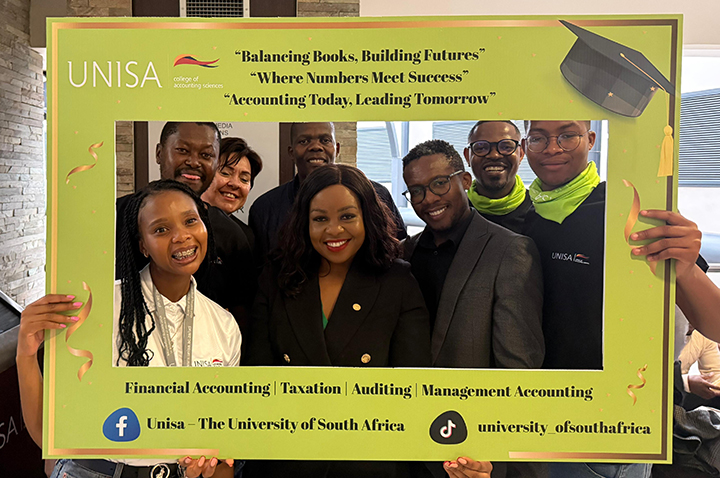 Unisa accounting career engagement draws students and industry leaders
 Unisa business management fundi calls for new research agenda on small businesses
 Strategic engagement between Unisa and UNAM opens doors for collaboration
 Unisans shine at major research conference