

The African college of excellence in the social and human sciences
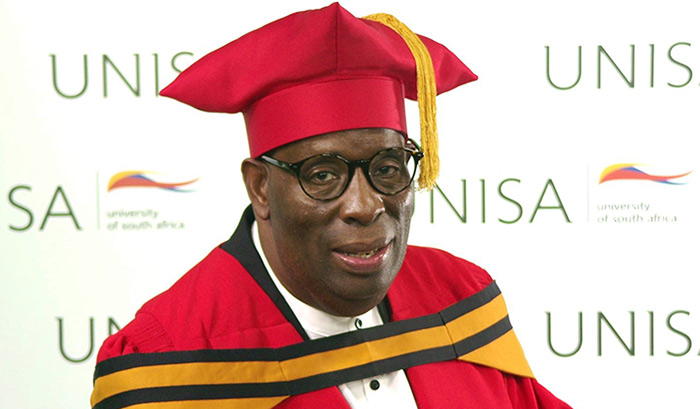
Prof Chitja Twala, Chair: Engaged Scholarship Portfolio, Department of History, College of Human Sciences
On 14 April 2026, Prof Chitja Twala delivered his inaugural lecture, titled "Liberation Routes and Safe/Transit Houses: Borderlands, Material Culture, and the Spatial Politics of Anti-Apartheid Resistance".
The lecture highlighted the often-overlooked role of safe and transit houses in sustaining anti-apartheid movements. The lecture explored how these spatial infrastructures functioned not merely as sites of refuge but as critical connections within the broader liberation networks. By strategically placing these spaces near borders, Twala demonstrated how geography, mobility and covert logistics interconnected to shape resistance strategies during apartheid. His analysis contributed to a body of scholarship that seeks to reinterpret liberation history through spatial and interdisciplinary lenses.
Following the lecture, an interview with Twala provided further insight into his academic journey, research interests and perspectives on higher education.
Reflecting on his academic trajectory, Twala emphasises that success is seldom the product of flawless execution, but rather of persistence through setbacks. He stresses that the true value of higher education lies not only in the acquisition of qualifications, but in cultivating the capacity to question, analyse and synthesise knowledge critically.
Addressing the challenges of balancing academic pursuits with personal responsibilities, he notes that he completed all his qualifications on a part-time basis while working as a history teacher, lecturer and head of department. He attributes his success to disciplined time management, structured scheduling and the support of his family, who understood the temporary nature of his academic commitments.
Twala’s research interests are rooted in liberation history and borderland studies, fields in which he has published extensively and established collaborations both across the African continent and internationally. He explains that his academic background in history and public administration shaped his focus on the political dynamics of liberation movements, both within and beyond South Africa’s borders. His lived experience in a society transitioning from apartheid to democracy further deepened his engagement with these themes.
Twala describes postgraduate supervision as a critical component of higher education. He argues that effective supervision, when conducted with rigour and care, has the potential to be transformative and to contribute meaningfully to knowledge production. Conversely, inadequate supervision can hinder academic progress. He further highlights that the discipline of history, marked by the enduring "scars" of the past, requires careful and professional interrogation to contribute to nation-building and social cohesion.
Distinguishing between supervision and mentorship, Twala advocates a blended approach. While supervision focuses on guiding academic outputs such as dissertations and theses, mentorship extends to supporting students’ personal development, career trajectories and resilience. He notes that this integrated approach enhances both academic success and holistic growth.
Having supervised and co-supervised numerous honours, master’s and doctoral students to completion, Twala describes supervision as both an intellectual and personal journey. He highlights that continuous engagement with student work sharpens critical faculties, particularly in identifying conceptual gaps and refining academic arguments. The impact of guiding students to completion, he adds, remains deeply fulfilling.
Reflecting on his decision to pursue a career in education, Twala points to his upbringing in a township and the broader socio-political context of the time. He describes teaching as a vocation shaped by personal experiences, values and the influence of dedicated educators who inspired his passion for the discipline of history.
Looking ahead, he proposes that higher education institutions should foreground the values of ubuntu within teaching and learning practices, particularly in addressing the needs of historically marginalised communities. Such an approach, he argues, would foster inclusivity, ethical engagement and social responsibility.
Twala is also actively involved in community engagement initiatives. At Unisa’s Department of History, he chairs the Engaged Scholarship Portfolio, which focuses on equipping history educators, subject advisors and curriculum specialists with skills to enhance the teaching of history at school level. He emphasises that community engagement plays a vital role in bridging the gap between academia and society, promoting social justice, civic responsibility and reciprocal knowledge exchange.
In terms of international collaboration, Twala is currently working with John Aerni-Flessner from Michigan State University in the United States on a research project examining the economic viability of small borderland towns during the 1960s.
At this stage of his career, Twala is focusing on academic publishing in collaboration with emerging scholars, with a particular emphasis on mentorship and skills transfer. He expresses a desire to leave a legacy defined by fairness, ethical integrity and the successful development of future academics who carry forward his values and intellectual contributions.
Through both his inaugural lecture and his broader academic work, Prof Mogurhoff Chitja Twala continues to make a significant contribution to the study of liberation history and the cultivation of a new generation of scholars.
* By IHlubi Veli Mabona, Marketing Assistant, College of Human Sciences
Publish date: 2026-04-22 00:00:00.0
 CRDB Bank CEO earns PhD from Unisa
 In a world of misconceptions, clarity is power
 CSET showcases research excellence at Unisa Research and Innovation Week 2026
 Celebrating a linguist in pursuit of greatness
 Unisa advances digital skills through robotics and coding initiative