News & Events
Unisa Press continues to illuminate the publishing space
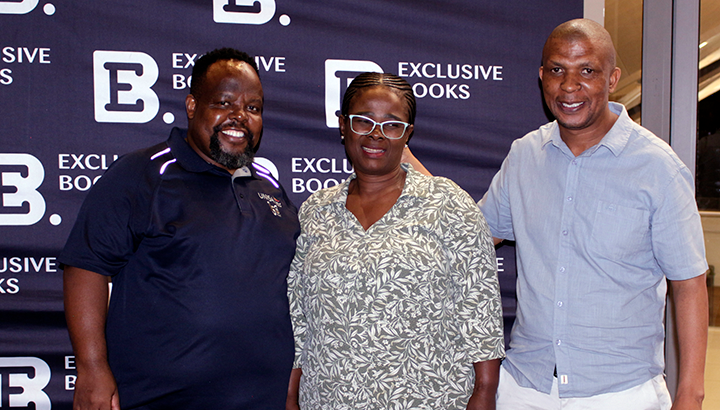
Dr Jack Chokwe, Dr Madira Thetso, and Dr Ntsoeu Seepheephe
Unisa Press, in collaboration with Exclusive Books in Rosebank, recently launched a book titled Sesotho History and Development, authored by linguist Dr Ntsoeu Seepheephe of the University of Lesotho, which demonstrates that Africans are one people.
Unisa Press was represented by Dikhoba Sekhutlo (Marketing Officer), Mbali Madonsela (Marketing Intern) and Dr Jack Chokwe (Project Editor). Sekhutlo was the programme director while Chokwe welcomed the audience and later presented a synopsis of the book. He also presented an etymological and morphological comparison of Nguni and Sesotho sa Leboa surnames.
These surnames include Shongwe – Chokwe. He highlighted that these clans originate from Eswatini and when the Shongwe tribe migrated inland, Chokwe was adopted and they share the same totems. He also argued that Chauke, which is a Tsonga surname, could potentially be linked to Chokwe, remarking that further research could be conducted to substantiate this claim. There is a town called Chokwe in Mozambique, and the Chokwe tribe in the Democratic Republic of Congo. Chukwu and Okechukwu, which are Nigerian surnames, could also be researched to determine any possible relations to Chokwe, a South African surname, to support the argument that Africans are one people.
Other surnames include Zwane – Ntswane, Malinga – Maleka, Mtshwene – Chuene, Nkambule – Kgaphola, Dladla – Hlahla, Madlala – Matlala, Masuku – Masogo, Maseko – Mashego, and Masombuka – Mosefoga. Although Chokwe highlighted these potential etymological and morphological similarities, further research is required to verify the accuracy thereof.
Some of the methods used to uncover the origins of the Sesotho language include DNA analysis, archival research, and literature review. The Sesotho history can be traced back to Cameroon in West Africa, through the migration of people to East Africa and Southern Africa. The Sesotho language is spoken in Lesotho, the Free State Province, some parts of the Gauteng Province, as well as in Zimbabwe.
Seepheephe was interviewed by Dr Madira Thetso from the University of the Witwatersrand, followed by a robust discussion among academic attendees from various universities. Sesotho was developed as a language by also borrowing from Nguni and Afrikaans languages. The etymology behind the naming of the farming implements in Sesotho can be traced back to Afrikaans.
During the launch, Seepheephe argued that borrowing is crucial to the development of a language. He maintained that the English language continues to be on a growth trajectory as its lexicographers are not shy to borrow from other languages. Afrikaans also developed as a language because of borrowing. The discussants, some of whom are linguists, arrived at an accord that adopting a purist approach, especially regarding technological terms, hinders the growth of African languages.
Despite limited resources, Unisa Press continues to illuminate the publishing space and remains the top scholarly publisher in Africa. It has significant distribution partners, such as Takealot and Exclusive Books at a local level, and Eurospan at an international level.
The Sesotho History and Development book is sold for R400 and can be ordered from Unisa Press’ website.
* By Dr Jack Chokwe, Editorial Project Manager, Unisa Press
Publish date: 2025-12-01 00:00:00.0