News & Events
Alumnus marvels at Unisa's transition from paper trails to digital excellence
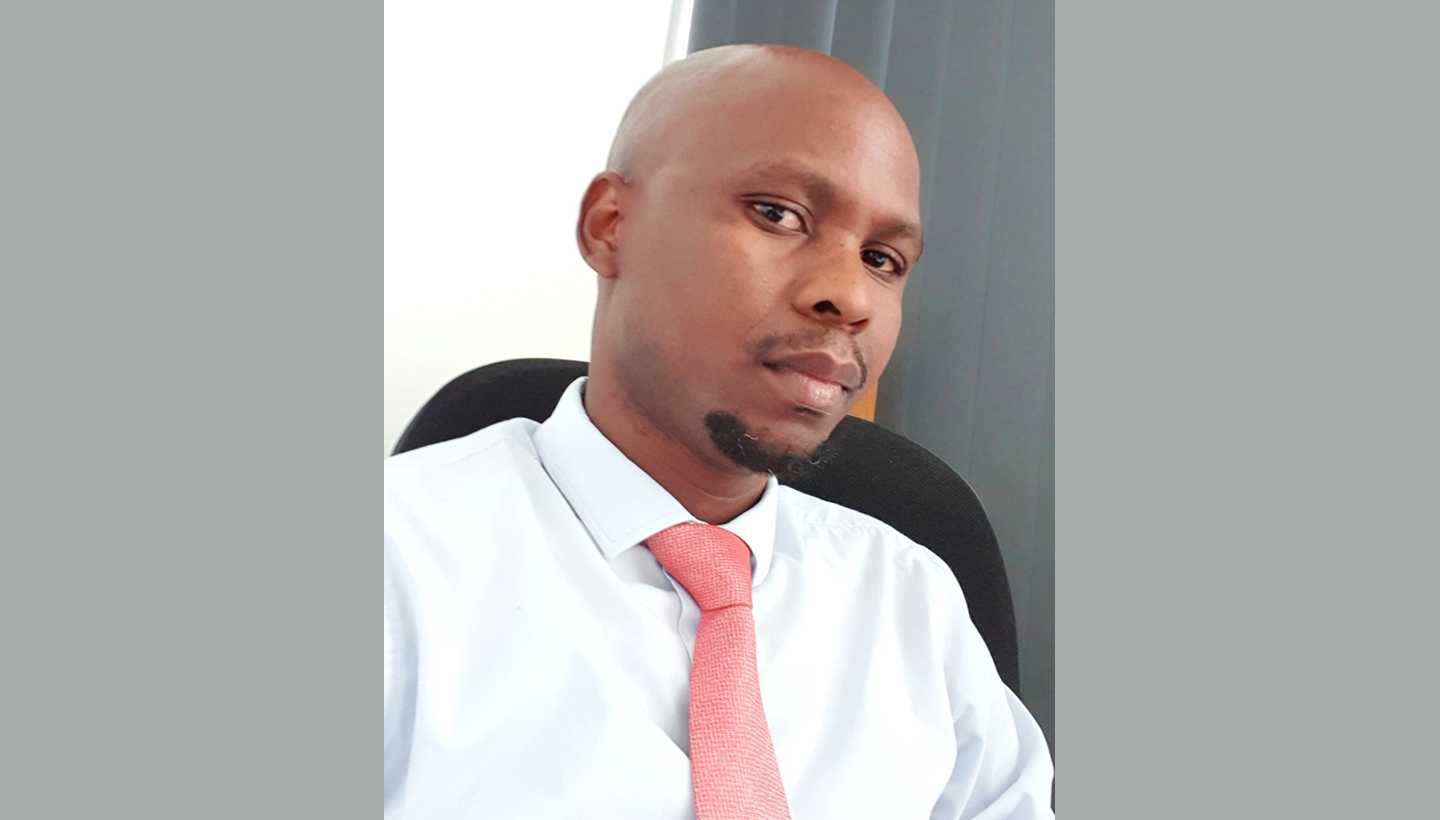
Sanele Jama
Sanele Jama can hardly believe how dramatically Unisa has changed. Moving away from the paper-based materials and venue-bound exams of his early student days, the university has evolved to conducting teaching and learning almost entirely online.
Sanele was one of the many educators who attended a recent career exhibition held on the KwaZulu-Natal (KZN) South Coast. A Unisa alumnus, he is also a master’s student at the university’s Faculty of Education. In addition, he serves as the KZN Department of Education Circuit Manager for the Ezingolweni Circuit in the uGu District. Sanele marvels at how far Unisa has come from the days of paper-based applications and exams to an era of digital excellence.
From paper to digital
Sanele has seen the landscape of higher education in South Africa undergo a profound metamorphosis over the last decade. As an educator, his academic journey with Unisa has offered a unique vantage point from which to observe (and get involved with) this singular evolution.
Sanele’s journey with Unisa began in 2011, when he enrolled in a Postgraduate Certificate in Education (PGCE) following his first degree, a Bachelor of Science (BSc) from the University of KwaZulu-Natal. After completing his PGCE, he embarked on a BEd Honours in 2013, again with Unisa.
Those days were marked by an administrative experience hampered by physical barriers, with most interaction occurring through standard postal correspondence or face-to-face student services offered by the regional offices. With the exception of a few emails and a limited amount of information available on the university’s website, the application and registration process were still very much paper-based.
According to Sanele, most of his studies at Unisa took place. At the same time, he was also a working professional, which meant he had to take a leave of absence whenever he needed to travel to submit documents in person at Unisa. The myUnisa platform existed, he says, but it was more like a secondary tool; student support was sparse, and navigating the digital space felt like an isolating challenge.
With his BEd Honours behind him, Sanele took an extended hiatus from academia before returning to Unisa in 2026 to pursue his master’s degree in education. He was astounded by how things had totally transformed, moving from paper-based activities to everything being online. The University’s technological leap had, by and large, been occasioned by the COVID-19 pandemic. Unisa, along with almost every other institution of higher learning, had been forced to transform almost overnight and move to virtual teaching and learning. The contrast, Sanele says, between his pre-COVID‑19 experiences and the current University landscape is a shift of revolutionary proportions.
The dawn of seamless administration
The most immediately obvious change is to the efficiency of the end-to-end administrative process. The transition to a fully online model, spanning applications, payments, and registration, has eliminated the bureaucratic hurdles of the past. In his words, “For a leader in the KwaZulu-Natal Department of Education, the ability to manage my academic status without compromising my professional responsibilities is invaluable.”
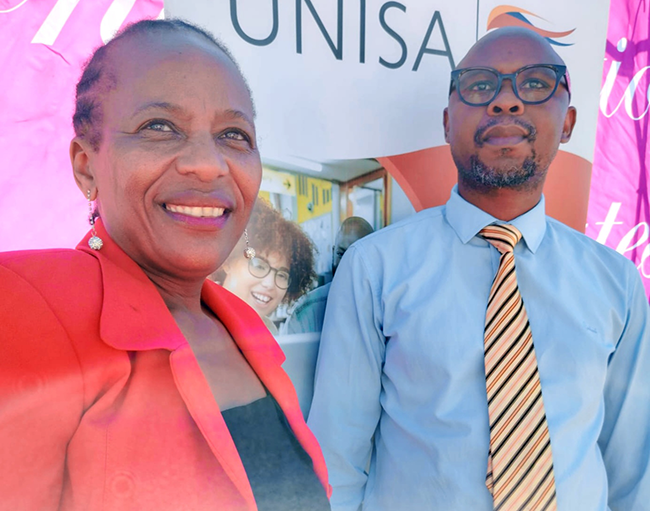
From left: Dr Joyce Myeza and Sanele Jama
Instructional support and connectivity
Beyond administration, the pedagogical support has also seen a significant upgrade. The newly modernised Unisa provides comprehensive orientation, ensuring that students are not merely registered but also equipped to navigate the digital learning environment. “Communication from lecturers,” he says, “is now proactive; we receive continuous updates on course developments, fostering a sense of academic community that was previously difficult to achieve in a distance-learning context.”
The virtual campus experience
Perhaps the most world-class feature of the current system is the accessibility of resources. The virtual library has removed the need for physical travel to regional centres. “I can now curate my research and download essential materials from the comfort of my home,” he says. “Furthermore,” he continues, “the human element remains intact; librarians are consistently accessible via email, providing expert guidance with remarkable speed.”
As he progresses through his master’s studies, Sanele says he is struck by how technology has been harnessed to put the student first. He stands in awe of how Unisa’s transformation into a digitally driven, student-centric institution has become a testament to higher education's ability to adapt to meet the needs of the 21st-century scholar. “For those of us balancing high-level professional roles with advanced academic pursuits,” he adds, “this digital shift is not just a convenience; it is an empowerment.”
In closing, Sanele said that meeting the KZN Regional Director, Dr Joyce Myeza, along with other Unisa representatives at the career exhibition, had prompted him to think more deeply and to appreciate how Unisa truly is the university in the service of humanity, both in mission and in deeds. “The perception of Unisa as an institution of higher learning catering largely for older, working people is a wrong and outdated perception,” he says. “That perception has been replaced by a digitally agile university ready to serve Gen Z as their university of choice.”
* By Siyabonga Seme, Manager: Communication and Marketing, KwaZulu-Natal Region
Publish date: 2026-05-05 00:00:00.0