News & Events
Advocating for disability transformation through servant leadership
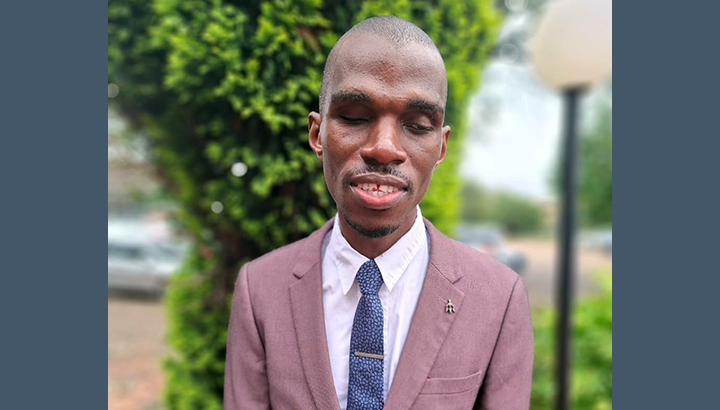
Thakhani Masuka
In celebration of Disability Rights Awareness Month, Unisa shares accomplishments of individuals with disabilities, who have made great strides in shaping the disability community through various leadership capacities. Thakhani Masuka is one such servant leader who promotes awareness and the rights of people with visual impairment.
Masuka is a visually impaired Unisa employee currently undergoing job-shadowing in the Department of Leadership and Transformation within the Directorate of Employment Equity. Masuka acquired his two degrees in politics up to an honours level at Unisa, through which he developed interest in disability activism with an intent of transforming the lives of vulnerable people with disabilities in South African.
During his academic journey and as he participated in student politics, Masuka was elected as the national Chairperson of the Unisa Association of Students with Disabilities. This role enabled him to pursue academic interests of many students with disabilities.
Masuka has been a member of Blind SA since 2018, demonstrating unwavering commitment to servant leader. Blind SA is a leading organisation in the South African blind community with more than three thousand beneficiaries. The organisation has made great strides in changing the economic and social lives of people with visual disabilities. In 2019, Masuka was appointed as a board member of Blind SA and served as the Chairperson of its Youth Committee, a position he held for almost four years. Accordingly, he enhanced the committee’s service to young people with disabilities.
During his tenure in the Youth Committee, Masuka introduced the National Youth Parliament of Learners with Visual Disabilities. This programme comprises of visually impaired learners from 16 South African secondary schools, and it serves as a platform to engage on matters that have a bearing on their learning wellbeing. The programme is also supported by some South African politicians and senior officials from the Department of Basic Education, who create time to attend this platform.
In 2022, Masuka was appointed as the Chairperson of Blind SA’s Economic Empowerment Committee, a position he held for two years. This committee serves the economic interests of people with visual disabilities, particularly regarding small, medium, and micro enterprises (SMMEs) owned by them. It was through this committee that he introduced the programme for Enterprise Development Day, in which various entities in the public and private sectors participate in order to afford SMMEs owned by this group the opportunity to gain entry to the Enterprise and Supplier Development (ESD) programmes initiated by the government and private sector. Therefore, the committee searches for business opportunities for such SMMEs in private and government entities.
Additionally, in June 2024, Masuka was appointed by the Minister of Communications and Digital Technologies to serve as a member in the B-BBEE ICT Sector Council. This is the council that advises the minister on the implementation of B-BBEE sector code in the information and communication technology sector. He is also serving as the Chairperson of the Review and Amendment Subcommittee in the same council.
In October 2024, he was appointed to serve as the Vice President of Blind SA, the second highest position in the organisation. He is also serving as the Chairperson of Blind SA’s Fundraising Committee, which comprises of internal and external members with fundraising expertise.
Further, Masuka has been working in the Enterprise and Supplier Development programme of Unisa from 2018 to 2025. Through this programme, he became part of the initiative that developed more than 700 exempted micro enterprises, as well as qualifying small enterprises. He played an integral role in ensuring that SMMEs owned by people with disabilities are also afforded the opportunity to participate in the programme by developing measures that promote reasonable accommodation for this group.
Masuka embraces the principle of disability activism, which upholds dedication in transformation, resisting fatigue in radical leadership. “Disability transformation requires courage and resilience without despondency,” he says.
Together, we can end disability marginalisation by joining hands to fight any system that preserves economic exclusion of people with disabilities.
* Submitted by the Department of Leadership and Transformation, and packaged by Nancy Legodi, Senior Journalist (Acting), Department of Institutional Advancement
Publish date: 2025-12-01 00:00:00.0