

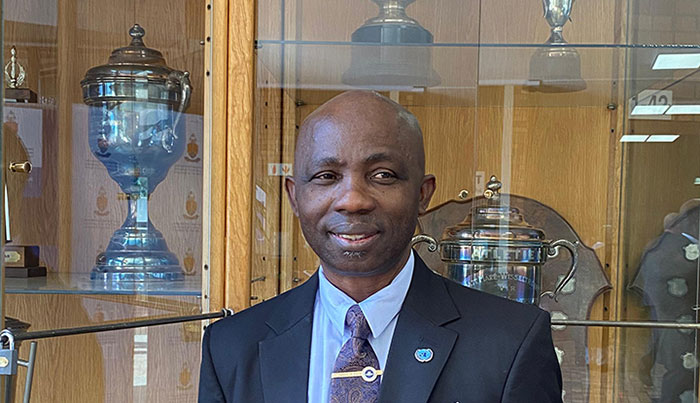
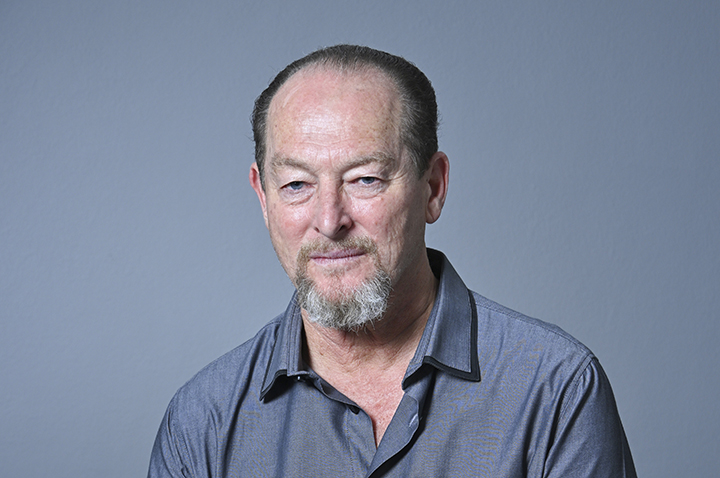
PhD candidate Abiodun Ebenezer Akinwale
Balancing the demands of a full-time professional administrative role with the rigours of doctoral research is no easy task. Yet for Abiodun Ebenezer Akinwale, a project manager at Unisa’s Directorate of Project Management within University Estates, Facilities and Operations, this dual pursuit has become a testament to resilience, discipline and unwavering commitment to academic excellence.
Currently a PhD candidate in the College of Science, Engineering and Technology, Akinwale’s thesis is entitled "Optimisation of Mechanical, Thermal, and Durability Properties of Wood Ash Concrete Incorporating Nanosilica". Having started in 2023, he is nearing completion under the supervision of Professors Walied Elsaigh (Unisa) and Ayinde Raheem (Ladoke Akintola University of Technology, Nigeria).
His academic journey spans decades, from a civil engineering qualification in Nigeria (1989) to an MBA (2013) and a Master’s Degree in Chemical Engineering (2019) at Unisa. Professionally, he lectured between 2009 and 2016 before moving into project management, where he has delivered over 16 institutional projects. Alongside his PhD, he also mentored two honours students to successful completion in 2025.
Despite such achievements, Akinwale’s doctoral journey has not been without obstacles. Even though he speaks highly of Unisa’s Professional Research Committee (PRC) and credits them with ample support across many aspects of his PhD journey, he also highlights some of the challenges he has experienced.
Examples of challenges cited by Akinwale include the lack of support, such as the absence of relevant training interventions, the refusal to include his research activities in his yearly performance agreement and the non-acknowledgement of duly submitted academic progress reports. These progress reports form part of the prescribed requirements for access to the Master’s and Doctoral Support Programme (MDSP) research grant, which is an institutional provision intended to support registered postgraduate candidates. The inability to obtain the required acknowledgement has adversely affected his access to programme benefits and, in turn, his progress.
Akinwale says that the challenges experienced during the execution of his doctoral programme without research development leave can best be understood in the context of competing academic and administrative obligations, which he describes as demanding and professionally taxing.
Akinwale adds, "Notwithstanding these challenges, I have taken encouragement from the enabling and supportive academic environment facilitated through the professional research committee, which has provided a platform for academic progression towards my PhD within the university’s scholarly community". He is of the view that being part of the Professional Research Group (PRG) is a crucial source of support, and he credits the PRC as instrumental in sustaining his progress.
With the committee providing Akinwale with both moral encouragement and financial assistance, he has published six research articles in high-impact journals. He has attended and presented at three international conferences. "My strategy is simple," he says. "Publish until you supersede the graduation requirements, and this requires burning the midnight oil throughout the study period."
Speaking on how his academic journey has shaped him both professionally and personally, Akinwale says he did not view his studies as daunting, but rather as a project. By doing so, he effectively applied his project management competencies, making the journey more structured and enabling him to achieve this significant academic milestone within the available resources and constraints.
He says progressing through his studies has strengthened his belief in himself more than ever before. His advice to other administrative staff members considering studies is that self-belief, discipline in overcoming procrastination and the willingness to defer social engagements temporarily are essential sacrifices for achieving greater long-term success.
Looking ahead, Akinwale says he plans to transition fully into academia, drawing on his experience in both teaching and project management to contribute meaningfully to higher education in South Africa.
Beyond his personal achievement, he hopes his experience will inspire institutional change. He advocates for a review of employee study support policies, particularly the requirement for line manager approval, which he believes may hinder equitable access to academic development.
Akinwale believes the PRC plays a vital role in supporting professional administrative staff who aspire to pursue postgraduate studies, as it offers a structured and specialised system.
He explains: "The PRC provides a specialised and focused platform that effectively addresses the unique academic support needs of this category of staff. The PRC functions necessitate dedicated, experienced and committed personnel with a clear understanding of research administration and academic development processes. Such capacity is presently evident within the PRC support structure, with its specialised mandate and sustained institutional focus."
Akinwale concludes by acknowledging the competence, commitment and professionalism of the PRC support staff. "Their proactive approach and dedication in processing requests in accordance with institutional requirements have been instrumental in enabling the timely support of my research dissemination activities, and for that I am truly grateful."
* By Rivonia Naidu-Hoffmeester, Professional Research Committee (PRC) Marketing and Communications Convenor
Publish date: 2026-04-14 00:00:00.0
 Unisa sparks critical conversation on South Africa's unfinished land question
 From Unisa graduate to global fraud intelligence investigator
 Studying at Unisa was the right decision
 More than a game: Unisa is building health, teamwork and lasting connections through sport
 How prominent researcher is changing lives and raising Unisa's global profile