

The African college of excellence in the social and human sciences
Body politics, masculinity, feminism, intersexuality and queer studies are just terminology right? Wrong. At Unisa’s Institute for Gender Studies these terms come alive in their research, teaching and everyday discourse.
As an interdisciplinary research institute located in Unisa’s College of Human Sciences, it is committed to raising awareness about gender issues in the Southern African context. It believes that raising awareness about gender is the only way to make progress towards eliminating GBV (gender-based violence), homophobia and transphobia as well as discrimination against women in the workplace and the political arena. This team further believes that education about gender is an effective way to achieve gender equality and the empowerment of women.
So how does the team play their part in raising awareness and making progress despite the challenges that exist? As a start, they promote scholarship as a way of changing society in Southern Africa to make it more gender equitable. Then they foster theory-led multi, inter and transdisciplinary research into all aspects of gender studies. Next they co-ordinate research projects into, for example, gender and representation, gender and ODL, gender and technology. In addition they also co-ordinate an interdisciplinary Honours programme in Gender Studies.
It’s a packed schedule everyday for them and we took some time to shadow the team and find out what a day in the life of the Gender Studies team looks like:
7:00 am: Dr Sinenhlanhla Chisale (Researcher) arrives at work and starts working on her publications. For example, her article for Gender and Behaviour journal on virginity testing.
8:00 am: Prof Deirdre Byrne (Head of the Institute for Gender Studies) arrives at work and starts replying to emails.
8:00 – 8:45 am: Byrne drinks coffee and deals with various crises regarding students, staff and reports that have not been submitted. Some of these student crises involve not having been assigned to supervisors, not submitting assignments by the due date, paid study fees but not having access to the library etc. Reports include lists of publications produced by members of the Institute.
8:45 – 9:00 am: Nomcebo Mwamusi (Administrator) arrives at work.
9:00 – 9:30 am: Byrne and Mwamusi discuss the deadlines that haven’t been met and how to stave them off. These deadlines are generally for reports on student pass rates, outputs produced, and research programmes to name a few.
9:30 – 10:00 am: Byrne attends to these deadlines after discussing with Mwamusi.
10:00 – 12:00 am: Byrne attends a meeting, usually of a management committee or the Institute has a meeting of one of their task teams. Their task teams are for tuition, research and marketing. Each one reports on what has happened in that portfolio in the past six weeks and plan for the upcoming months.
9:00 – 12:00 am: Dr Amritesh Singh and and Dr Chantelle Gray van Heerden (both Postdoctoral Research Fellows) work on their research conference presentations and publications. Singh is working on a book about versions of Shakespeare in Bollywood films and Gray van Heerden is working on a poststructuralist reading of anarchist feminist writing.
12:00 – 16:00 pm: Byrne and Chisale mark assignments, answer phone calls and write reports, tutorial letters and examination papers.
13:00 – 14:00 pm: Time to get some lunch. The team members who can take an hour away from their office go and have lunch at one of the Unisa cafeterias.
16:00 pm: Byrne and Chisale leave the office to go home.
16:00 – 17:00 pm: Mwamusi attends to administrative tasks and goes home. These include submitting claim forms for external examiners, following up on claims by external examiners, booking venues for meetings and events, arranging catering for events, publicity of events and filing.
17:00 – 19:00 pm: Byrne and Dr Chisale work on their laptop computers at home.
19:00 – 20:00 pm: Dinner.
20:00 – 23:00 pm: More work before turning in for the night before starting the next morning with renewed enthusiasm.
See the gallery below on some of their activities:
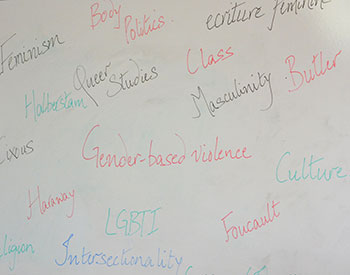
At Unisa’s Institute for Gender Studies these terms come alive in their research, teaching and everyday discourse. |
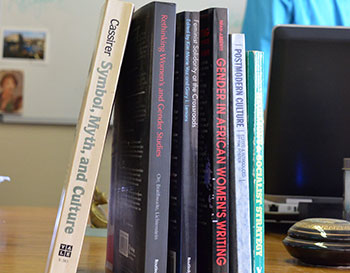
This is a team that is well read on topics they believe in the most. |
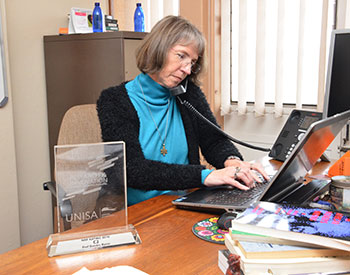
As Head of the Institute, Bryne deals with lots of emails, telephone calls and other admin in a day. |
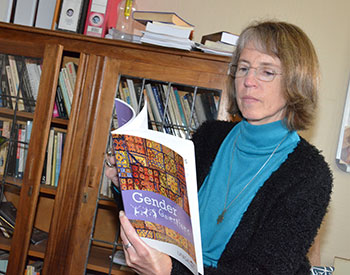
When she gets a rare moment, Bryne pulls away from her computer to taking a ‘reading break’. |
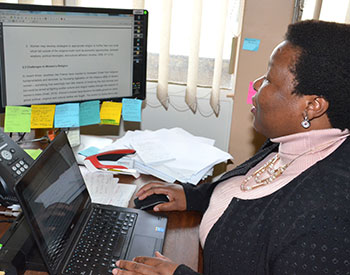
Chisale busy marking a student’s assignment. |
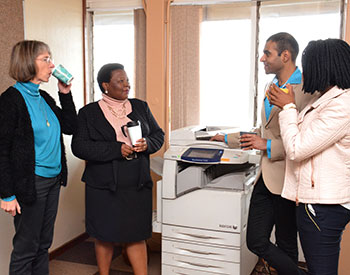
When they all arrive at the same time at the photocopy machine and it turns into a gender discourse…with coffee of course! |
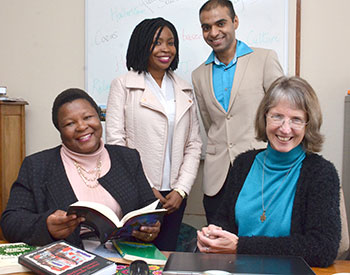
This is a team that believes wholeheartedly in raising awareness around gender issues and making as much progress as possible through their research and teaching. Pictured standing: Nomcebo Mwamusi and Dr Amritesh Singh and seated: Dr Sinenhlanhla Chisale and Prof Deirdre Byrne. |
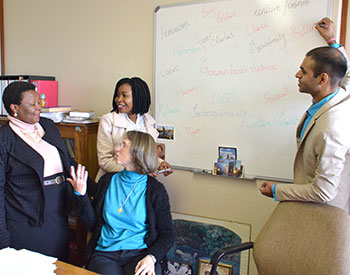
Group discussions are always lively. |
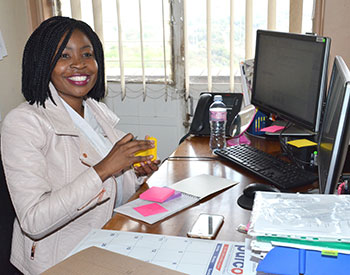
Mwamusi is always covered by a mountain of admin but she handles it with a smile. Of course, sticky note reminders don’t hurt either. |
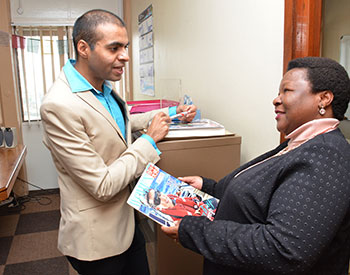
Even bumping into each outside Byrne’s office other turns into a gender discussion for Singh and Chisale. |
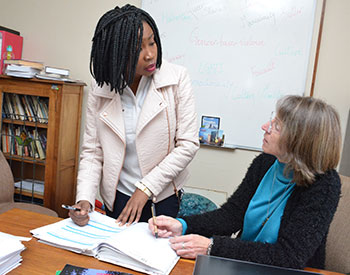
Mwamusi and Byrne discussing the deadlines that haven’t been met. |
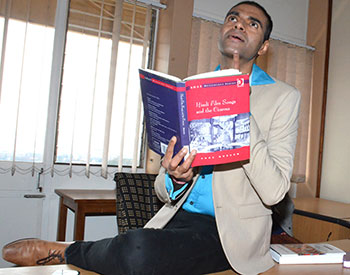
Singh is deep in thought about his book on versions of Shakespeare in Bollywood films. |
*By Kirosha Naicker
Publish date: 2017-01-24 00:00:00.0
 Unisa hosts workshop to empower postgraduate student support and quality assurance
 Learn how astronomy and space science are strengthening SA's research and innovation landscape
 From campus mailboxes to two million followers: The untold story of Unisa's digital revolution
 Working, studying, succeeding: Inside Unisa's life-changing employee education programme
 Meet the Unisa professor transforming mathematics education